Passive Gain
Gain, efficiency, directivity, and polarization analysis from HPOL + VPOL chamber pairs.
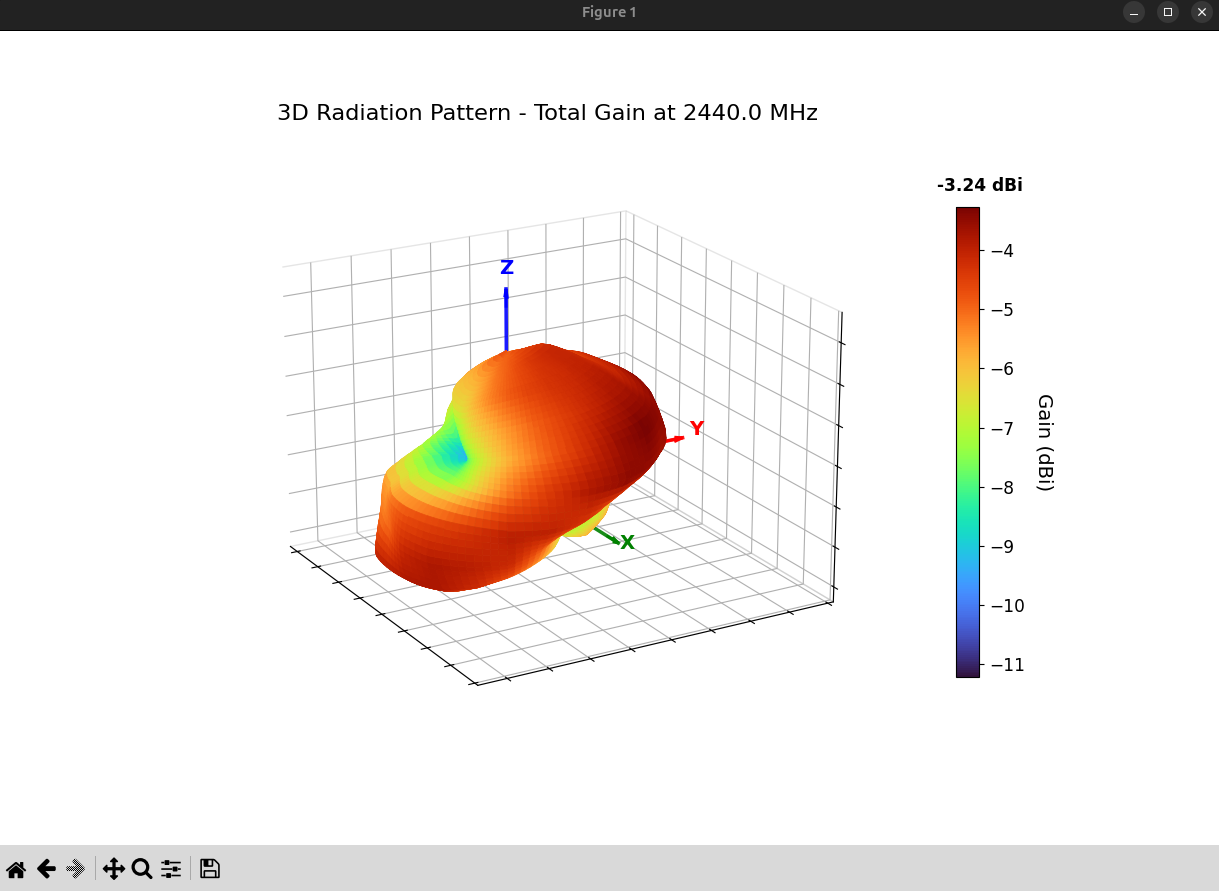
What you need
- A WTL HPOL
.txtfile (*_HPol.txt) - The matching VPOL
.txtfile (*_VPol.txt) - Optional: cable loss in dB
In the GUI
- Scan type: Passive
- Set
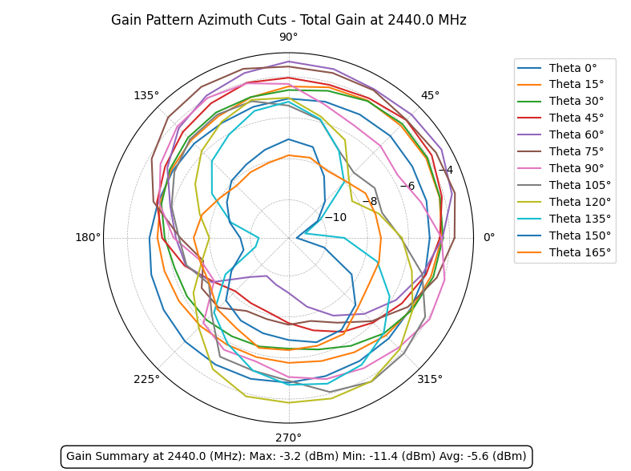
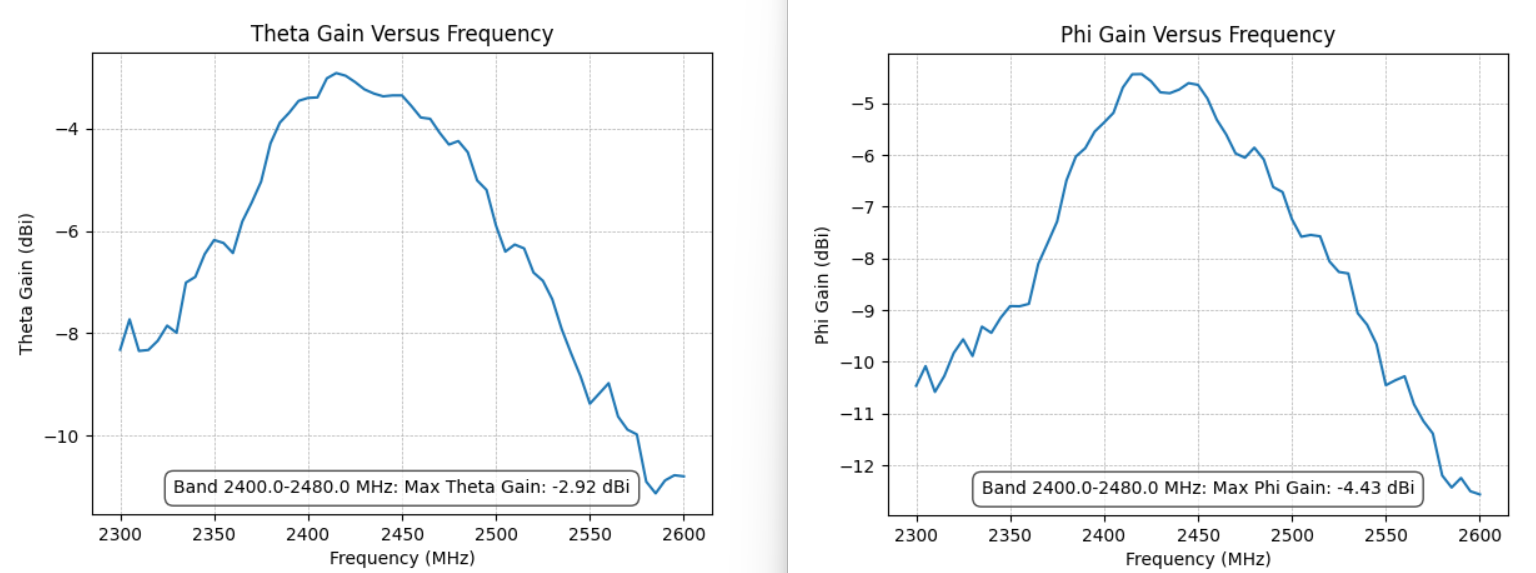
Cable Loss (dB)if applicable Ctrl+Oand pick the HPOL file — RFlect locates the matching VPOL automatically- Plots render: 1D gain/efficiency vs frequency, 2D azimuth/elevation, 3D pattern, optional datasheet plots
What you get
| Metric | Notes |
|---|---|
| Total gain (dBi) | $10\log_{10}( |
| H-gain / V-gain | Ludwig-3: HPOL → $E_\phi$, VPOL → $E_\theta$ |
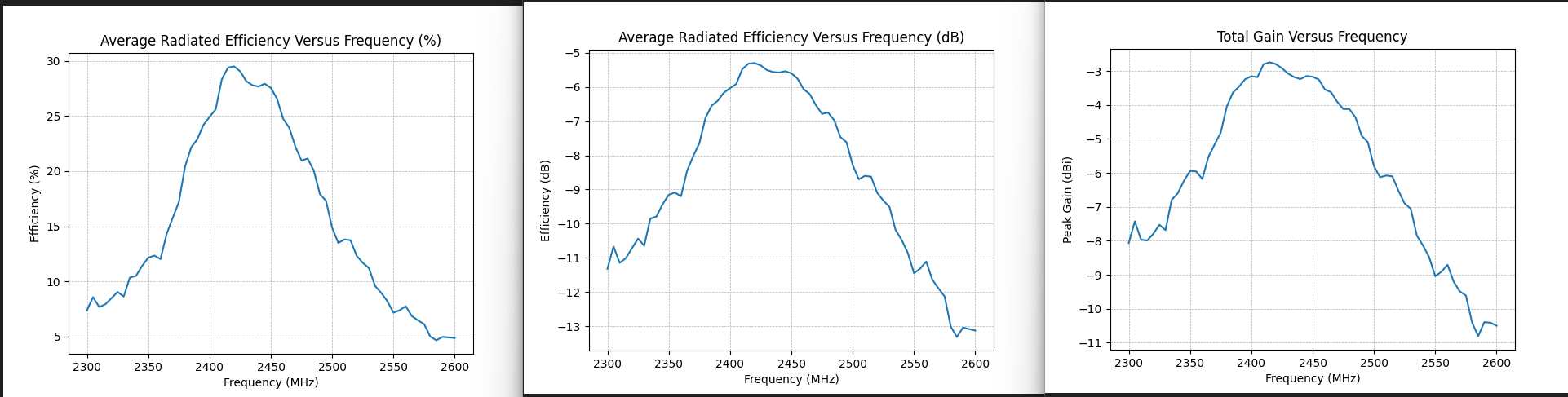
| Efficiency | Spherical sin-weighted average gain |
| Directivity | Peak gain − average gain |
| Axial Ratio / Tilt Angle / XPD | Polarization-ellipse metrics (see Polarization) |
| Sense (RHCP/LHCP) | From phase-difference $\delta$ between $E_\theta$, $E_\phi$ |
2D azimuth cuts
1D efficiency vs frequency
Datasheet output
Math conventions
- Ludwig-3 polarization — HPOL is $E_\phi$ (azimuthal), VPOL is $E_\theta$ (elevation). See
plot_antenna/calculations.py:637. - dB averaging — convert to linear first: $10\log_{10}(\text{mean}(10^{dB/10}))$, then back. Never average dB directly.
- Spherical average — sin-weighted to account for the smaller solid angle near the poles.
Batch / MCP
Process every HPOL/VPOL pair in a folder:
process_folder("/path/to/wifi_antenna", intent="passive", report=True)
# or restrict to specific frequencies:
process_folder("/path/to/wifi_antenna", intent="passive",
               freqs=[2400, 2450, 2500], report=True)
See Recipes.
CST export
Combine HPOL + VPOL + VSWR into a single CST Farfield Source file:
Common gotchas
- HPOL/VPOL filenames must match. RFlect pairs them by prefix and the
_HPol/_VPolsuffix.validate_file_pairchecks angle/freq alignment. - Cable loss is the same for both files. If H and V used different cables, you'll need to pre-correct the files.
- Efficiency vs gain — efficiency is the spherical-average; peak gain is much higher than average gain for directive antennas.