Advanced RF Analysis
Five analysis modules added in v4.1.5 that go beyond chamber-only metrics.
Link Budget / Range Estimation
Friis transmission with protocol presets (BLE, WiFi, LoRa, Zigbee, LTE, NB-IoT). Computes maximum range given TX power, antenna gains, frequency, and required SNR.
$$P_r = P_t + G_t + G_r - 20\log_{10}!\left(\frac{4\pi d}{\lambda}\right) - L_{\text{cable}}$$
Indoor Propagation
Implements ITU-R P.1238 (distance-power loss with floor-penetration factor) and ITU-R P.2040 (material penetration loss).
Environment presets: Office, Hospital, Industrial, Residential, etc. Each preset preloads the appropriate path-loss exponent.
Multipath Fading
Rayleigh and Rician CDF curves plus Monte-Carlo simulation. Useful for estimating margin in cluttered environments.
Enhanced MIMO
- Capacity curves — Shannon capacity vs SNR with correlation effects
- Combining gain — selection, equal-gain, maximal-ratio (verified math; see Math fixes)
- MEG — Mean Effective Gain with XPR (cross-polarization power ratio)
Wearable / Medical
Body-worn pattern adjustments. Dense-device SINR. SAR screening estimator.
Math fixes (v4.0.0)
The original combining-gain formula was wrong. v4.0.0 verified:
- Diversity gain uses the Vaughan-Andersen formula $DG = 10\sqrt{1-\text{ECC}^2}$ — NOT a log-based formula.
- Combining gain validated against simulated MIMO-EVK data; agrees to within float precision (one pre-existing test still rounds
4.999…vs5.0— unrelated to physics).
Kraus efficiency caveat
Kraus formula:
$$\eta_{\text{Kraus}} = \frac{32400}{\text{HPBW}_E \cdot \text{HPBW}_H}$$
Only valid when both HPBW values ≤ 180°. RFlect rejects results that produce $\eta > 100\%$ — the assumption breaks for omnidirectional or low-directivity antennas.
Accessing these modules
Tools menu → Advanced RF Analysis. Sub-dialogs are scrollable since the parameter set is large.
There are currently no MCP wrappers for these modules. Open an issue if you need one — most are pure-Python in plot_antenna/advanced_* and could be wrapped quickly.
RF method gallery (v6.0)
The figures below are authentic outputs of the new v6.0 RF methods
(plot_antenna/rf_methods.py, exposed as MCP tools). Regenerate them with
python docs/generate_example_figures.py.
Uniform linear array — electronic beam steering
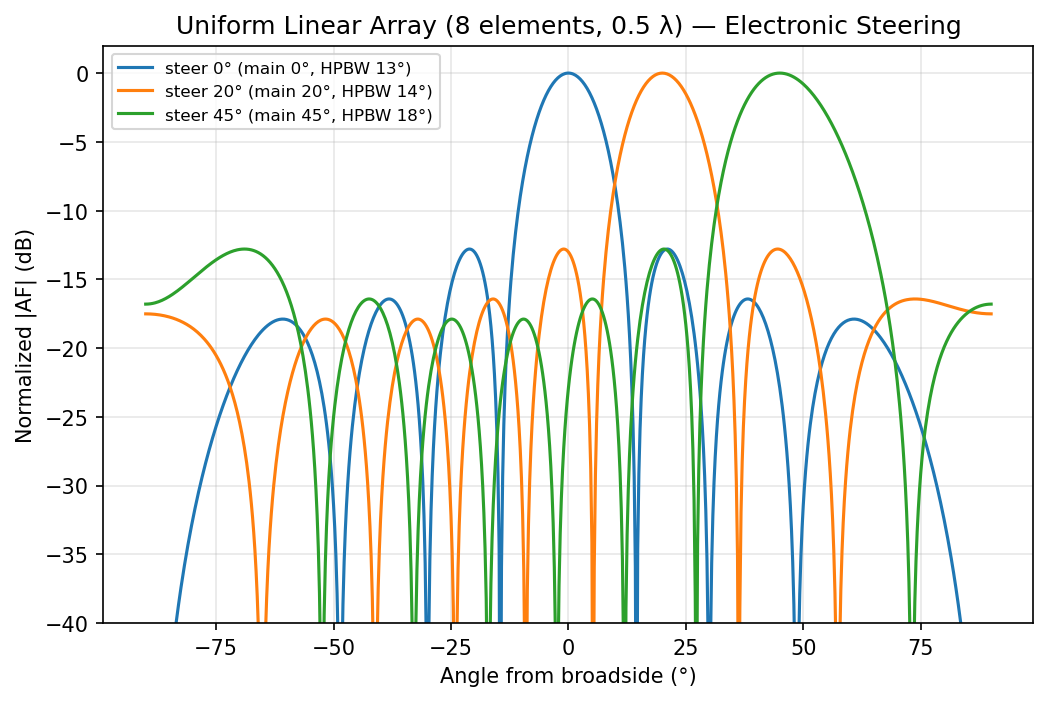
An 8-element, 0.5 λ array steered to 0°, 20°, and 45°. Note the main beam broadening (scan loss) as it steers off broadside — the reported HPBW grows from ~13° to ~18°.
Aperture taper trade-off
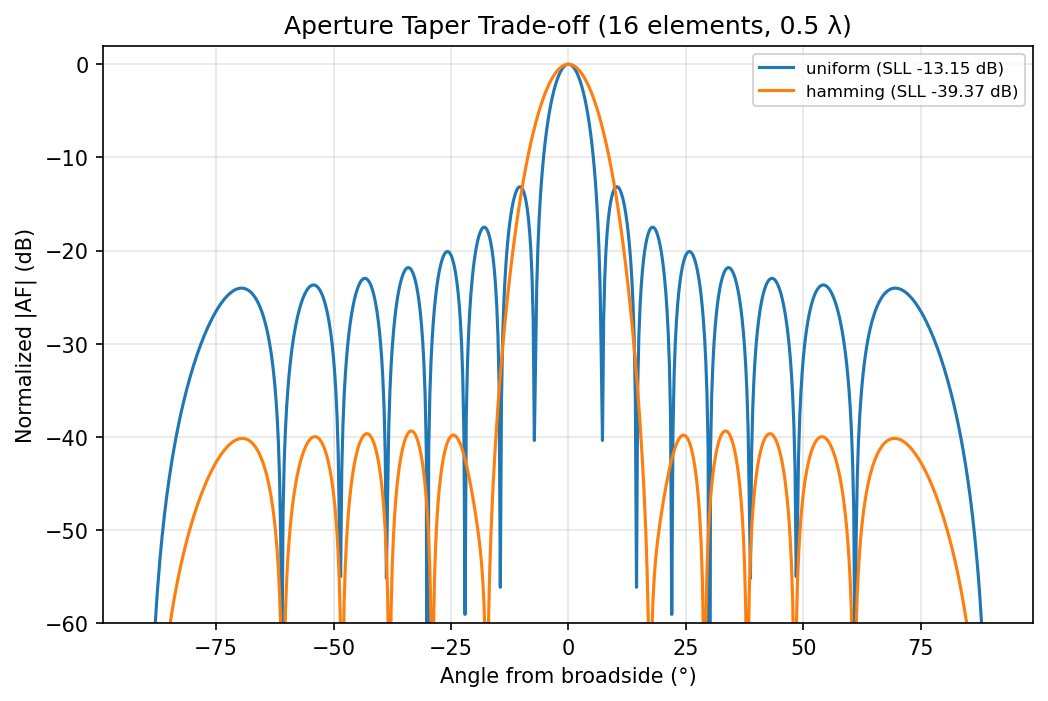
Uniform vs Hamming taper on a 16-element array: the taper trades ~3 dB of main-beam width for a large drop in peak sidelobe level.
Axial ratio vs H/V phase
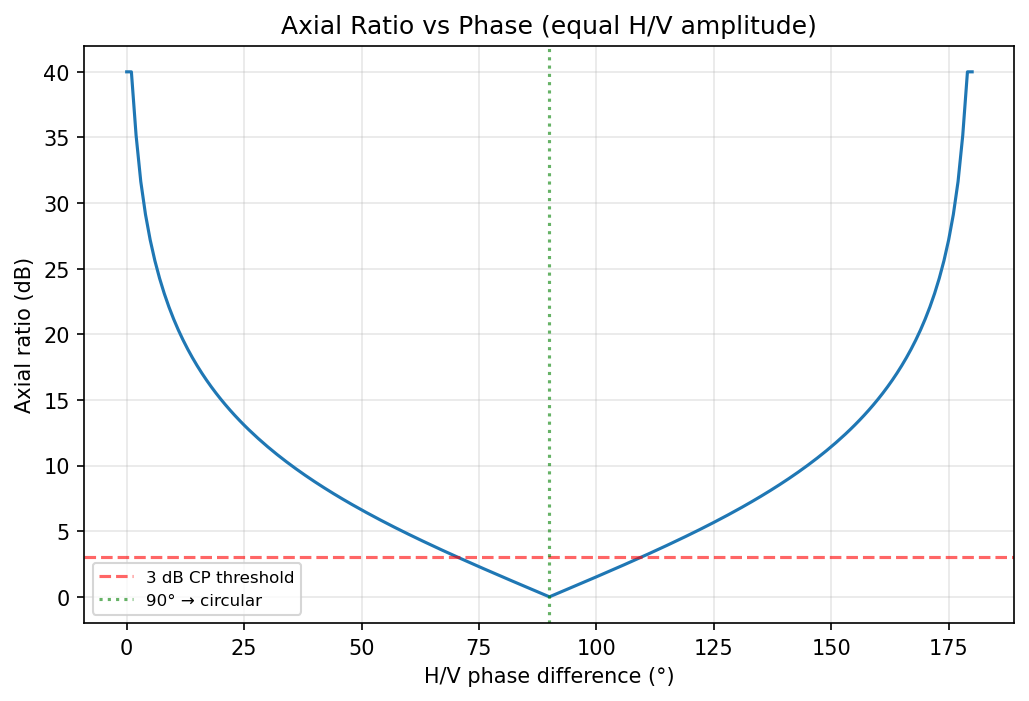
With equal H/V amplitude, axial ratio dips to 0 dB (perfect circular polarization) at a 90° phase difference and rises toward the linear-polarization asymptote at 0° and 180°. The 3 dB line marks the usual CP acceptance threshold.